Friday, August 23, 2019

Part of a Community


Over the last seven months, working as an AmeriCorps member for the parks has given me an insight into the great respect and pride Montanans have for the environment and their state and national parks. In recent years, Montana State Parks has attracted over 2.5 million people annually. On the busiest of days, tour guides at Lewis & Clark Caverns State Park can expect to collectively educate upwards of a thousand people. This means that no two days of working at the caverns are ever the same. I never know what combination of children and adults I am going to get, whether they will be seasoned cave explorers or excited for their first ever cave, a boisterous group of 32, or a personalized tour just the two of us. This ambiguity is part of the draw for many individuals seeking a job in the outdoors.


Working outside often means getting your hands dirty. For two weeks in July, I concentrated efforts between tours on a 1.9-acre section near the exit tunnel to remove a very prolific invasive weed- musk thistle. There are native and nonnative thistles, but all of them have a prickly stem and leaves that laugh at the thin material covering your hands and a stubborn taproot that threatens to send you rolling down the hill when finally removed. Even so, I found that the tricky task builds gumption, and pride in one’s work. Upon my triumphant return each day I presented my bounty to the ticket sellers, a sign of recognition for all they do, in the form of a lovely musk thistle bouquet.

When working for a park, you wear many hats and cater to the flux of visitors. Over the past decade, visitation with the state parks has increased almost 40%, greatly outpacing the budget, which has remained relatively stagnant over this time. To combat this deficit, my position was originally created in 2017 as a ten-month service term. Recent listings rank Montana sixth in the nation for AmeriCorps enrollment. Over 800 members served statewide with schools, veterans’ facilities, and public lands in 2018. 

I am one of 17 Montana State Parks AmeriCorps members serving this year across the state. Beyond the in-house duties of education and preservation, we are also expected to have a presence at other parks and local communities. Once a year, all of us come together for a service project and All Corps gathering. I work at Lewis and Clark Caverns with another summer AmeriCorps member Michelle, and it was a special treat for us to host the event this year at our park. 

During the gathering, we learned brushing techniques to clear a trail and spent an afternoon removing branches and trees crowding 1.1 miles of the East Side hiking and biking trail.


We also worked as a team to remove knapweed from 1.3 acres of the park.


Kate, Julianna, Amber, and Victoria ^^                       Isabella >


All the while, we used the time to reconnect, enjoy the beauty of the park, and recharge in our downtime.


Later in the summer, a number of us represented State Parks at the Butte Folk Festival. For the last 11 years, the city of Butte has invited a wide variety of musical artists for the three-
day event, attracting 170,000 visitors annually. We were stationed in the family play area, with a lassoing activity. All of us had a fun time showing kids how to use a lasso to rope wooden horses, especially since most of us barely knew what we were doing. I also got a bat wing painted by my eye, just so I could “bat my eyes” at people. At the end of my shift I met up with former AmeriCorps member Jake, who came back this year as a tour guide. We partook in some of the festivities, dancing to some spicy Cuban music.


The next week, Michelle and I were sent out to our local community to assist with Whitehall Frontier Days. I helped to organize floats and individuals as they arrived to line up for a parade and later walked along the sidelines as the parade progressed. Representing the park in the town I currently call home made me feel more connected, and my presence sparked many inquisitive questions locals had about the parks system and the caverns.


But if you ask any park employee, there is anticipation in the air in the early part of July as all preparations are finalized for the largest park event statewide. Bannack Days entices 6,000 visitors annually, requiring the cooperative efforts of countless volunteers, many of which are park staff borrowed from other parks. Bannack State Park is a historic park created to protect the buildings that arose during the gold rush, over 100 years ago. Bannack Days reawakens the culture and spirit of the abandoned town with booths, activities, and reenactments, transporting visitors back in time. 

Visitors could pan for gold, take a wagon ride, make their own candle, or even cheer on a hanging.


Although there are many park events across the state that call on the assistance of AmeriCorps members, Bannack Days is all hands on deck. Fifteen of us arrived from all over the state to play an integral part in helping the event run smoothly by helping to park cars, sell tickets, and drive shuttle vans.


Mindy shuttling visitors                                                                   Kyle assisting with parking

Will, the AmeriCorps member working at Bannack, gave us a tour of the park the day before, introducing us to his temporary home. Everything from the unique flora of the park to the historic structures felt like a playground welcoming us to explore. In fact, a number of us embraced our inner child while riding the nearly 100-year-old merry-go-round.

 Amber
  

These community events have been some of my favorite memories from the summer. It is a great way to be a presence at local gatherings and also to gain a greater insight into how the Montana State Parks system functions overall. For such a large, sparsely populated state, Montana has taught me a lot about service and supporting each other. 

If any of this has piqued your interest and you think you or someone you know would enjoy this type of work, you can apply today. Montana State Parks AmeriCorps has just opened the application for next year’s full term positions. You could be in my position at Lewis & Clark Caverns State Park in 2020, helping to organize events and educate the influx of visitors, all the while learning what it means to be part of a community.


Tuesday, June 18, 2019

Discovering Lewis & Clark Caverns State Park


     Vase Flower                                    Skunkbush Sumac                                  Spring Beauty


Summer is finally here! Flowers are blooming, birds are singing, and days are getting warmer. Although we are still getting cold spells, a green blanket covers the hills, transforming the previously barren landscape. One difference I had not foreseen between New York and Montana was how late it gets dark. It currently doesn’t get dark until after 10pm and on the Summer Solstice, June 21st, it may be light until after 11pm! With all these promising signs coinciding with the end of the school year, it is no wonder visitation at Lewis & Clark Caverns State Park is increasing. There are many activities, events, and special presentations offered throughout the week good for audiences and families of all ages. Check out the link at the bottom to get a coupon in honor of June Family Month!

This past May 18th marked the 9th annual Kids to Parks Day. Parks all over the country celebrated this day by hosting different activities, presentations, and talks oriented towards getting kids enthused about the outdoors. Lewis & Clark Caverns had never participated in this national day of play before, and I envisioned it as a great way to attract local families.

When I was in the early planning stages for this event, I attended the Montana Environmental Education Conference in late March. While there, I connected with many nature-based organizations and told them about my idea to host an event with educational booths, informational speakers, a guided hike, a Junior Ranger program, and maybe even a food truck.  Many seemed very intrigued and enthusiastic about the idea and before long my wallet was insufficient to house all the business cards I had collected! By mid April the majority of the event details were set; now to get creative in promoting the event.

I had never had to promote a completely new event and tried to think out of the box to
capture audiences across the board. I created radio advertisements, newspaper articles, asked local schools to promote the event, made Facebook events/reminders, worked with mayors of the neighboring towns of Whitehall and Three Forks to get the day officially proclaimed, and even did a TV interview (link at the bottom). However, I had the most fun creating stickers for school-age kids on tours to take home and show their parents.

The day of the event, we had around a dozen organizations set up tables for visitors to enjoy all day. Some of these included a table on skulls and skins hosted by ZooMontana, complete with a live great horned owl (T-L), Montana Outdoor Science School had a table on arthropods (B-L), CFWEP brought live macro invertebrates for kids to capture and ID (T-R), and the Smart Schools booth aimed to teach kids about recycling and waste (B-R). Since I was roaming around all day, I had the privilege of showing a wild rubber boa we had found and were using for educational purposes before releasing it later that day (C).


There were also special presentations offered periodically throughout the event. The park ranger, Julia Smit, hosted a Junior Ranger program, Bill Cook gave a Bear Aware program (B), Duane Buchi presented on the significance of grizzly bears to Lewis and Clark, and I led a guided hike at the end of the day (T-L). Blue Smoke BBQ food truck was a welcome sight when they arrived midday, just in time for lunch (T-R). Although, it was not the best weather, with a light drizzle all day, that didn’t stop over 70 visitors from having a great time partaking in all the activities!


Simultaneously, I have also been helping to lead tours and activities up at the cave. We offer two types of tours on a daily non-reservable basis: the Classic 2 hour, 2 mile moderately strenuous tour, and the Paradise 1 hour, 1 mile easy tour. It has been a pleasure leading groups through the cave and getting to experience all the perks of the recent lighting and handrail update project. Over the winter, extensive measures were taken to make the cave more accommodating with new stainless steel handrails that bend smoothly around formations and tight spaces, lights in the handrails lighting up the walkway, and more light in each room revealing formations previously in the dark.


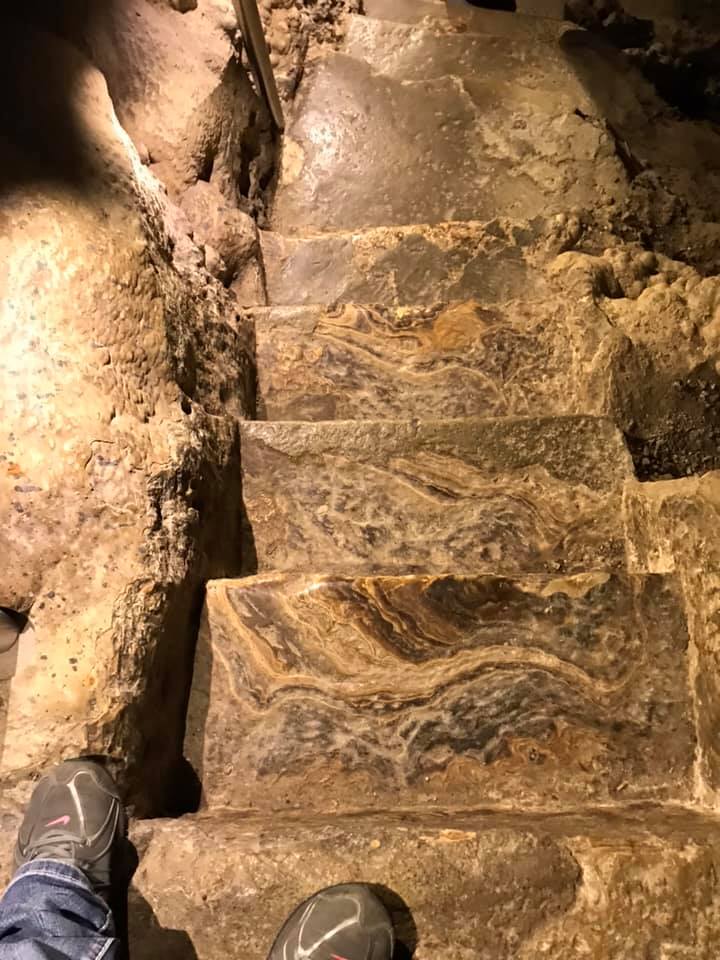
Brown Waterfall Room                     Limestone Carved Steps                              Cave Bacon


      Stainless Steel Handrails                                                         Crystal Pool

Personally, I tend to lead a majority of the Paradise Tours. These tours offer a short and easy option for those who have a restriction that does not allow them to do the full 2-hour moderately strenuous tour. Patrons on this specialized tour see all of the same formations and receive very similar information, all the while entering the cave on a flat trail that leads straight to the largest room in our cave system—the Paradise Room.

Photo: Andy Austin- Montana State Parks

The highlight of the month so far for me, however, was National Cave and Karst Day, June 6th. To celebrate this day, I demonstrated to patrons that the rock that makes up the cave, limestone, is made from the shells of ancient sea creatures. Seashells are made of calcium carbonate, which creates bubbles and fizzing when it comes in contact with acid. I then had patrons choose from a number of rocks to determine which one was limestone and tested them by using hydrochloric acid (skull and crossbones container). This got many oohs and ahs from even the youngest of onlookers.


With all of this going on and much more, June is a perfect time to stop by, especially for families. In honor of making tours more affordable for families, we are offering a coupon for two adults and two children (additional members will be charged the regular tour rate of $12 ages 12 and up, $5 for ages 6-11). Check out the special interview with Assistant Manager, Tom Forwood, highlighting the new lights, tour options, and June Family Month (see links below). Stay tuned next month for updates on summer happenings.

Photo: Andy Austin- Montana State Parks


Saturday, May 11, 2019

Shining Light in Dark Spaces


When I originally accepted my AmeriCorps position at Lewis & Clark Caverns State Park, I knew working underground would prove to be a very unique experience; I did not realize, however, that I was arriving in the midst of the largest renovation project the cave has seen since the park was first developed in the 1930s. Within a few days of starting in January, I had the privilege of joining in on a trip into the cave to document the progress of updating the lights and handrails. This was my first look into the cave, and it included a backstage behind-the-scenes look--so needless to say, I was taking pictures of everything!


An important part of any major project on public lands is publicity and transparency. Joining us for the day was Fish and Wildlife news reporter, Chet Layman. As we walked through the construction occurring in the cave, we got to witness workers drilling post holes for handrails and laying new wiring for the lighting system. These much-needed improvements replaced old handrails and lights that dated back several decades.


As the newbie in the group, I had the benefit of getting to be Chet’s acting cameraman for
interviews he conducted. In the first interview, at the mouth of the cave, Assistant Park
Manager Tom Forwood highlighted some of the large-scale aspects of the updates (links to all interviews are located at the end). He mentioned that with the removal of incandescent lights, light emissions are going to be reduced—in effect, causing a decrease in the excess heat emitted that can dry out formations, cost to light the cave, and algae build up. Inside the cave, an interview with Cave Specialist Julia Smit expanded upon the intricacies of accomplishing such a project in an underground work zone. “Every time they make a cut [removing old handrails], they are having to make sure they are not sending all of those particles onto the cave formations.”


During the summer season, Julia Smit also works as the Park Ranger for the park. She was hired by the state as the cave specialist to mediate what is best with the cave with what needs to be done for the project. Her expertise and input ensured that there was always an open dialogue between the project manager and the park. Some of the lengths taken that went above and beyond normal protocols included old handrails being put in bags before being transported out of the cave, the drill for handrail posts being fitted with a splash guard, concrete being mixed in a sealed area, and work benches designated to concrete platforms only.


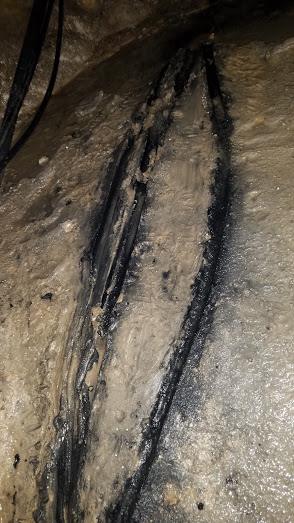
One consequence of leaving cable in a cave with a constant rate of humidity of 90% for several decades is that the casing around the cable eventually starts to deteriorate, contaminating whatever it is touching. During a cave clean up, I got to assist in removing this sludge that had built up around the cables and covering them with fresh cave dirt.


Needless to say, this project was no minor feat, but in two months the construction company made leaps and bounds with the updates in the cave. In late March, Chet Layman returned to get a final look at the updates in the cave. This time I got to step up my camera skills, performing some angle shots for the two interviews Chet did with Tom (left). By this point, most of the stainless steel handrails were put in and the lights that shine down onto the walkway had been hooked up. The same day we got to do a second run through with Fish, Wildlife, and Parks video producer, Winston Greely (right).


In total, over 11,000 feet of branch circuit cable were replaced. The largest length of cable, a section of the power feeder, was 135 feet at 1.5 pounds per foot. There are over 2200 feet of that main power feeder in the cave. The old and new post cores that were drilled to remove old handrails and establish new ones respectively, often had some very unique designs to them. One of the new cores was drilled out of flowstone and reveled a pocket of air that had allowed a miniature formation called a helictite to grow inside of it! Throughout the cave, 224 post holes were cored in preparation for the new stainless steel handrails. Black styrofoam was used to transport the 970 feet of new handrails safely into the cave. 

 
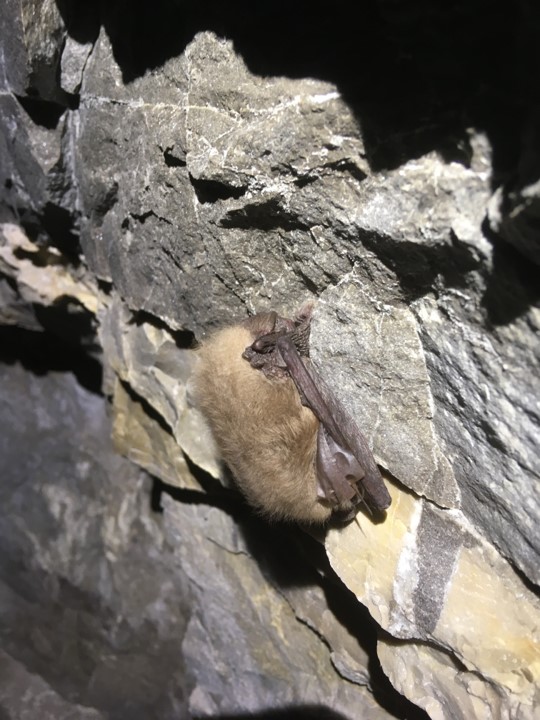
No bats were harmed in the duration of this project. In preparation for the noise that would ultimately disturb the bats trying to hibernate, music was played all day starting in October when the project began. The constant noise was a method to hopefully encourage the bats to hibernate elsewhere. We are happy to say that after having fewer bats than normal over-winter in the cave, we have a healthy number of bats, including our most famous Townsend’s Big Eared bats that have returned for the summer.

This part of the project is actually Phase II of a renovation scheme to update all the lights and handrails in the cave. The first portion took place in 2007, giving the Paradise Room an updated look. The Red-Green-Blue lights in the Paradise Room accent the natural mineral-stained pinks, whites, red/oranges, and browns. 

Although the major driving forces behind the renovations were safety for visitors and health of the cave, aesthetics were also taken into account. Julia spent many tireless hours crawling into tight spaces to put lights where they had never been before, run cables through small cracks to mostly hide them from the pubic, and adjusting lights to the perfect angle. There are formations lit up now that easily could have been overlooked in the past. 


Whether you have never been to the cave or make the park an annual visit for your family, Lewis & Clark Caverns promises a whole new experience for every visitor!

Videos:

Chet Layman Fish and Wildlife interview January 2019- Assistant Park Manager, Tom Forwood: 

Chet Layman Fish and Wildlife interview January 2019- Park Ranger, Julia Smit:

Chet Layman Fish and Wildlife interview April 2019- Assistant Park Manager, Tom Forwood:

Chet Layman interview April 2019- Assistant Park Manager, Tom Forwood- cave opening:

Winston Greely FWP interview April 2019- Park Manager, Rhea Armstrong and Assistant Park Manager, Tom Forwood: